The new vehicle registration plates are updated twice a year on the first day of March and September. This year, the much anticipated ‘25’ and ‘75’ plates will be introduced, with the former arriving in March, and the latter taking over in September....
For many motorists, this is an exciting time—whether they enjoy driving a brand-new car, appreciate the prestige of a fresh plate, or simply love the novelty. Enthusiasts may also enjoy these months as the latest car models often release alongside the new plates. Many dealerships see a rise in sales during these months.
What’s in a Number Plate?
Let’s break down the number plate and see how they are formatted and what information we can learn about a vehicle.
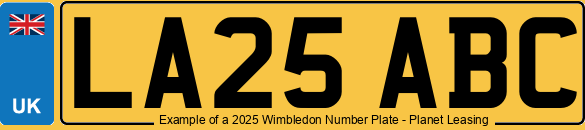
On the far left of the plate, there is a distinguishing sign. This usually contains a flag and an abbreviation of the country of registration underneath. These are optional, and not compulsory. There are some exceptions, including a solid green strip, indicating a car produces zero emissions. Fully electric or hydrogen fuel cell cars registered from 8 December 2020 and onwards come fitted with these green strips.
The first two letters are known as a memory tag, a system used by the DVLA which indicates the area in which a vehicle was first registered. Each DVLA office has its own memory tag identifier, followed by a local identifier that further narrows down the registration area. For example, a vehicle registered in London would begin with the letter ‘L.’ The Wimbledon office assigns local identifiers from ‘A–J,’ while the Stanmore office uses ‘K–T’, and Sidcup using ‘U-Y’. With this in mind, a vehicle with a number plate beginning with ‘LA’ can be identified as being first registered in Wimbledon.
Letters ‘I,’ ‘Q,’ and ‘Z’ are excluded due to their resemblance to numbers, while ‘Q’ is specifically reserved for vehicles of uncertain age or identity. The letter ‘O’ may appear when a vehicle is registered in Oxford.
The two numbers represent the year of registration. Vehicles registered in March and onwards simply use the year in question, while those registered in and after September follow a different pattern, adding 50 to the year. Hence this year’s number plates will be ‘25’ and ‘75’.
The final three letters are randomly generated and are used to ensure each plate is unique, allowing specific vehicles to be identified. Since these are allocated in blocks to dealers, you’re likely to see cars from the same manufacturer with letters that are in sequence.
Personalised Number Plates
Personalised number plates are one of the many ways you can customise your car and make it truly your own. While the UK does permit personalised plates, there are rules you must follow.
The DVLA sets guidelines which ensures that all plates:
- Are made from a reflective material
- Display black characters on a white background (front plate)
- Display black characters on a yellow background (rear plate)
- Do not have a background pattern
- Are marked to show who supplied the number plate
- Are marked with a British Standard number - this is ‘BS AU 145e’ for plates fitted after 1 September 2021
- Do not have removable or reflective characters. If your number plates were fitted after 1 September 2021, they must also be a single shade of black
- Do not contain any offensive words, phrases or symbols
- Use the legal spacing and fonts
- Do not make the car to appear newer than it is
The DVLA has a marketplace in which you can search for plates that contain what you are looking for, bid on auctions, or speak to licenced dealers to further customise your plate. You do not have to follow the standard format of licence plates, for example, dateless plates are available for purchase.
You may also customise your plates with different text effects including 3D, 4D, gel and so on. This can be a great way to add visual flair to your plates and is legal in the UK as long as the plates follow the DVLA requirements regarding legibility, colour, front, spacing and reflectiveness. Failure to comply with these regulations can result in a fine from £100 up to £1,000, a failure on your MOT and potential penalty points on your licence.
If you've bought a new car, you can transfer your private plate from your old vehicle. To do this, you'll need to notify the DVLA by completing a V317 form online or by post, and there’s an £80 fee for the transfer. Both cars must have a valid V5C, and if they are over three years old, each must have a current MOT certificate.
At Planet leasing, we only lease brand-new vehicles (unless it's from our new Used EV Offers section) and can provide you with cars sporting the latest plates. If this is something you are interested in, be sure to get in contact with our incredible sales team!